The Style Secret That Makes Every Outfit Look Better
How to Dress for Your Skin Contrast
Have you ever seen someone wearing a simple white T-shirt and dark jeans and thought, How do they make that look so good?
Then you try the exact same outfit... and something feels off.
It isn't that the clothes are wrong.
It isn't your body.
More often than not, it's because the contrast of the outfit doesn't match the contrast of your face.
This is one of the most overlooked principles in personal style, yet once you understand it, you'll start seeing it everywhere.
It's also one of the fastest ways to make your wardrobe look more intentional without buying anything new.
Let's break it down.
What Is Skin Contrast?
Your natural contrast is simply the difference in lightness and darkness between your:
- Skin
- Hair
- Eyes
- Eyebrows
Some people have dramatic differences between these features.
Others have features that blend together much more softly.
Your clothing creates contrast too.
Think about these combinations:
- Black and white
- Navy and white
- Charcoal with light gray
- Cream with camel
- Sage with stone
Some combinations are bold.
Some are subtle.
The goal is to match the level of contrast in your clothing to the level of contrast you naturally have.
When those two work together, your face becomes the focal point.
When they fight each other, your clothes get all the attention.
Why Different Color Combinations Look Better on Different People
This isn't a hard-and-fast rule.
Think of it more like a principle that helps explain why some outfits naturally look more balanced than others.
Research has shown that we're surprisingly sensitive to facial contrast—the light-to-dark differences between a person's eyes, hair, eyebrows, lips, and skin. Those differences influence how we perceive a face, including impressions of health and vitality. The clothes you wear become part of that visual picture.
That's why the exact same outfit can look incredible on one person and just "okay" on someone else.
When the contrast in your clothing echoes the natural contrast in your features, the whole image feels more cohesive. Your face remains the focal point instead of competing with your clothes.
It's subtle. Most people couldn't tell you why one outfit looks better than another.
They'll simply think you look polished, put together, and like everything works.
That's the goal—not following rigid rules, but creating harmony between what you're wearing and the person wearing it.
Here’s how to use this styling trick in your life.
Step One: Find Your Contrast Level
The easiest way is with your phone.
Take a selfie in natural daylight.
Now turn the photo into black and white.
Color disappears.
All that's left is light and dark.
Now ask yourself:
How different are my features?
Do my hair, eyebrows, eyes and skin create dramatic separation?
Or do they blend together?
Most people fall into one of three categories.
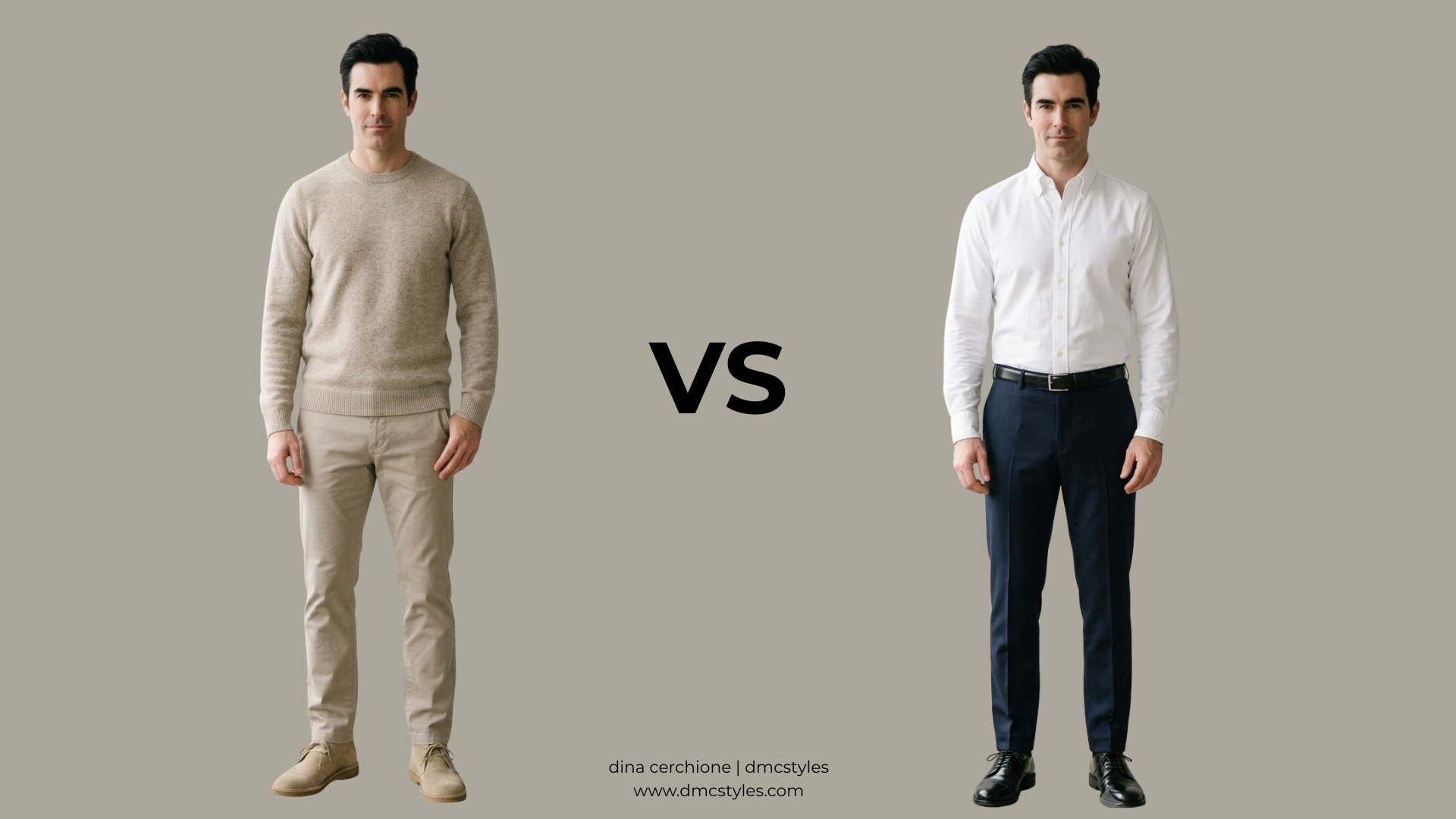
High Contrast
What it looks like
You likely have:
- Fair skin with dark brown or black hair
- Very dark skin with bright eyes
- Strong eyebrows
- Clear separation between facial features
In black and white, your face has obvious light and dark areas.
You look best in:
- Black and white combinations
- Navy with white
- Deep charcoal
- Crisp white shirts
- Bold jewel tones
- Rich emerald
- Burgundy
- Sapphire
- Strong geometric prints
- Clean stripes
High contrast outfits mirror your natural features.
Instead of overpowering you, they reinforce what already exists.
Great combinations
- White Oxford + navy trousers
- Black polo + light gray chinos
- Navy blazer + white shirt
- Black leather jacket + white tee
Avoid
Head-to-toe muted beige.
Very low contrast outfits can make high-contrast people look surprisingly tired.
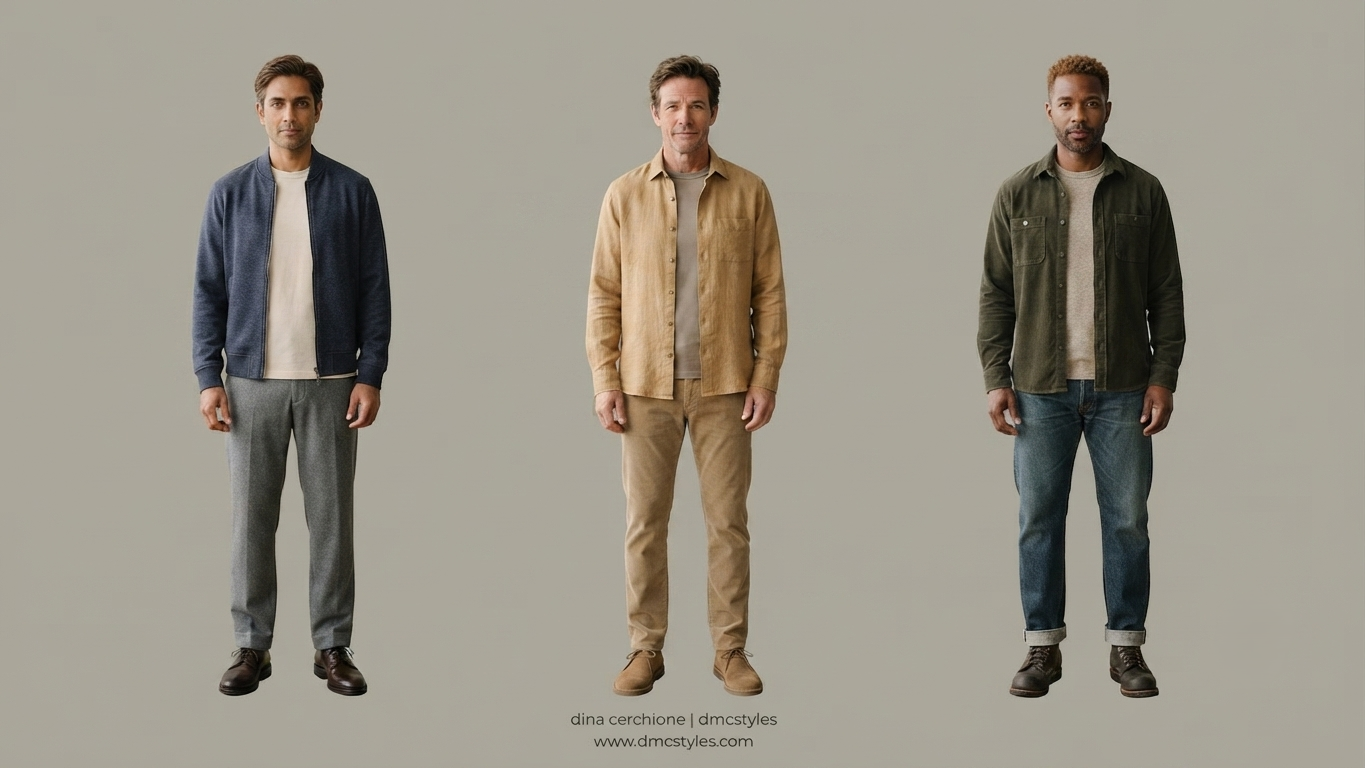
Medium Contrast
What it looks like
Most people fall here.
Your skin, hair and eyes have noticeable differences but nothing dramatic.
You might have:
- Olive skin with dark brown hair
- Tan skin with medium brown hair
- Medium skin with hazel eyes
Your face has definition without being extremely bold.
You have the most flexibility.
You don't need maximum contrast.
You don't need everything tonal.
Instead, think about having one strong point of contrast while keeping everything else cohesive.
Great combinations
- Navy polo + khaki chinos
- Olive overshirt + white tee + dark denim
- Chocolate polo + stone pants
- Mid-wash denim + cream sweater
Earth tones work exceptionally well.
Medium washes often outperform extremes.
Avoid
Too much black and white.
Too much beige from head to toe.
Either extreme can throw off your natural balance.
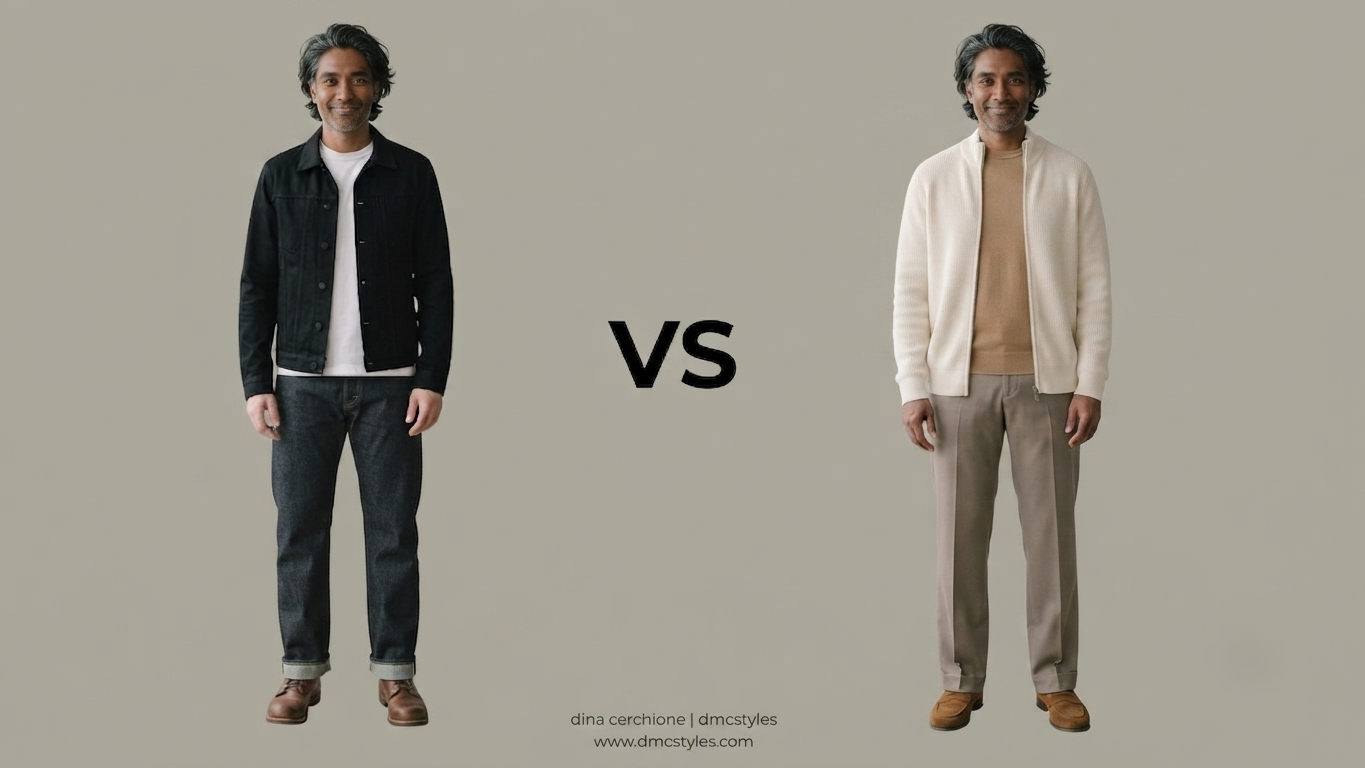
Low Contrast
What it looks like
Your features are naturally softer.
Examples include:
- Blonde hair with fair skin
- Light brown hair with light skin
- Deep skin with equally deep hair and eyes
In black and white, your features blend together more than separate.
That isn't a weakness.
It simply means your best outfits create harmony instead of drama.
You look best in
- Cream
- Camel
- Taupe
- Stone
- Sage
- Soft blue
- Warm gray
- Monochromatic outfits
- Tonal dressing
Instead of wearing black next to bright white, try:
- Cream with camel
- Charcoal with medium gray
- Olive with sage
- Navy with medium blue
These combinations allow your face to remain the focus.
Avoid
Extremely harsh black-and-white combinations directly next to your face.
For many low-contrast people, they can make your complexion appear flatter and your features less noticeable.
Does This Mean You Can Never Wear Certain Colors?
Absolutely not.
This isn't about rules.
It's about emphasis.
You can wear black even if you're low contrast.
You can wear cream even if you're high contrast.
The difference is where you wear those colors and what you pair them with.
For example:
A low-contrast man who loves black might wear:
- Black pants
- Black shoes
- Soft gray knit
- Medium charcoal jacket
Instead of:
- Bright white shirt
- Jet-black jacket
Same color palette.
Different level of harmony.
Contrast Is Only One Piece of Great Style
Contrast matters but it works alongside:
- Fit
- Proportion
- Fabric
- Color temperature
- Your personal style
- Your lifestyle
Think of contrast as another tool.
It's not the entire toolbox.
But it's one of the easiest upgrades you can make immediately.
Try This Today
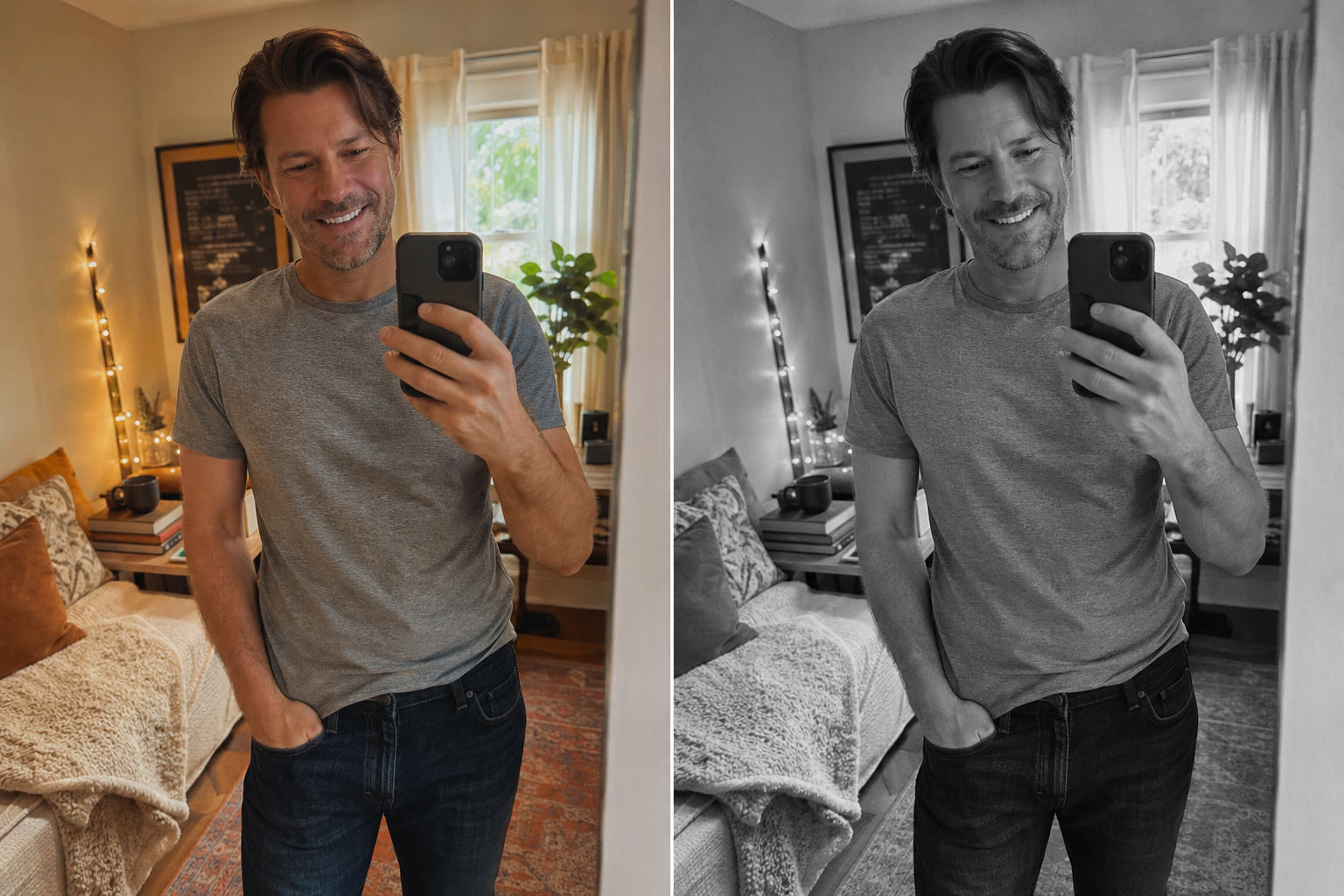
Open your camera.
Take a selfie in natural light.
Convert it to black and white.
Now look at the outfit you're wearing.
Is the contrast in your clothing similar to the contrast in your face?
If not, experiment.
Swap a black shirt for charcoal.
Replace a bright white tee with cream.
Try darker pants with a lighter top—or soften the overall look with tonal pieces.
You'll be surprised how much more balanced your appearance becomes without changing your style.
Sometimes the difference between an outfit that feels "fine" and one that feels polished isn't buying something new.
It's simply choosing the right level of contrast for the person wearing it.
When your clothing works with your natural features instead of competing against them, people notice you first.
And that's exactly what great style is supposed to do.
About the Author
Dina Cerchione is a personal stylist for men and the founder of The Men's E.D.I.T. She helps ambitious men use the power of presence to reach their goals — through intentional wardrobes built around their real lives, not trends.gemi