Stop Affirming Who You Are. Start Affirming What You Do — The Mindset Shift That Changes How Men Dress
If you're building a business, leading a team, raising kids, or closing deals, you already know one thing: results come from action. You've built your life around execution. You don't wait to feel motivated to do the work — you show up, you decide, you move.
So why does the story sound completely different the moment style comes up?
Most high-performing men who know they need to address their image don't have a shopping problem or a budget problem or even a taste problem. They have a narrative problem. And it's the one thing quietly capping how far their image — and sometimes their confidence — can actually take them.
The Narrative Problem Most Men Don't Know They Have
The narrative usually sounds like one of these:
- "I'm not stylish."
- "Clothes aren't really my thing."
- "How I dress doesn't matter that much."
- "I have bigger priorities."
These statements feel like self-awareness. Like you're just being realistic about who you are and where your energy goes. But they're not harmless. They're identity labels — and identity labels, when repeated often enough, become self-fulfilling constraints.
Here's why this matters specifically for men who operate at a high level: in every other domain of your life, you don't let a fixed label determine your ceiling. You don't say "I'm not a good leader" and leave it there — you develop your leadership. You don't say "I'm not a closer" and write off your ability to sell — you learn, you adjust, you get better. You operate from standards, not from static self-descriptions.
But when it comes to image, the fixed narrative gets a pass. And it sits there, quietly limiting what's possible, while you keep telling yourself it's just not your thing.
Why Identity Labels Cap Performance — Even in High Achievers
This isn't about mindset fluff. There's real cognitive science behind it.
Research in behavioral psychology consistently shows that identity-based framing — "I am" statements — activates a very different mental mode than action-based framing — "I do" statements. When you describe yourself with a fixed label ("I'm not stylish"), your brain files that as a settled fact and stops looking for evidence to the contrary. It stops generating options. It stops problem-solving.
But when you anchor your thinking to behavior and action — "I make clear decisions about how I present" — your brain shifts into execution mode. It starts looking for what's actionable. It starts treating the situation as something within your control, because you've framed it as something you do, not something you are.
The distinction sounds subtle. The cognitive impact is significant.
High performers in any domain understand this intuitively. They don't wait to feel like a confident speaker before they develop their speaking. They don't wait to feel like an athlete before they train. They define a standard and operate from it — because standards drive behavior in a way that identity labels simply don't.
The same principle applies to your image. And it starts with replacing the labels.
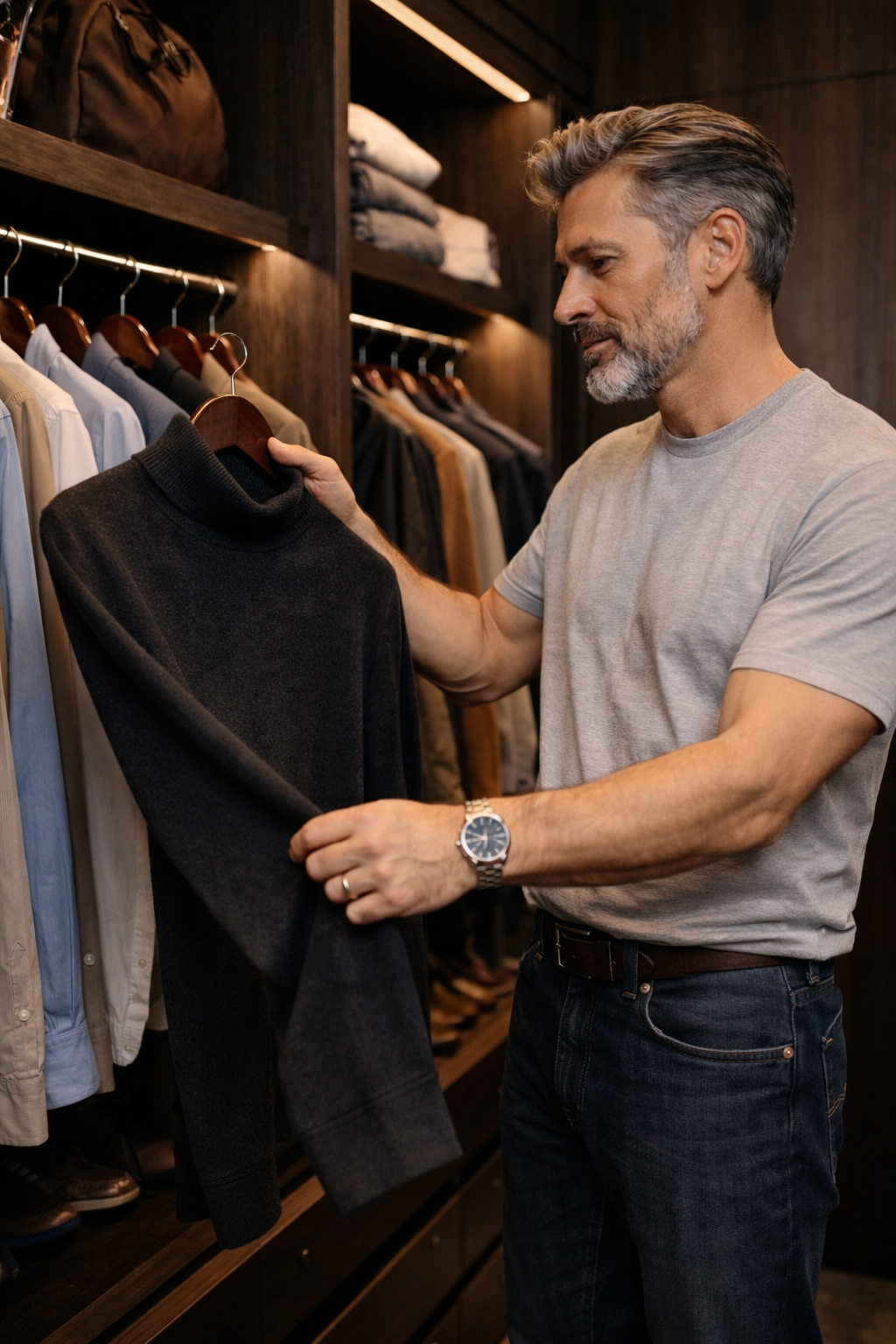
Step 1: Replace Identity Labels with Action Statements
This is a simple exercise with a real impact. For every fixed identity label you carry about your style, replace it with an action-based reframe. Here's what that looks like:
Instead of: "I'm not stylish."
Think: "I'm learning what works for me and getting rid of what doesn't."
The first statement closes the door. The second one opens a process — one you're already equipped to run, because you've built your entire professional life around learning and optimizing.
Instead of: "How I dress doesn't really matter."
Think: "My presence is part of my leverage."
The first statement removes image from the equation entirely. The second one recognizes what high performers actually know: how you show up — visually, physically, energetically — is part of how you move through the world and influence outcomes.
Instead of: "I don't have time for this."
Think: "I set this up once so I don't think about it daily."
The first statement treats style as an ongoing time drain. The second one recognizes what a well-built wardrobe actually does — it eliminates the daily decision fatigue entirely. You invest the time once, intentionally, and then you stop spending mental energy on it every morning.
Instead of: "I'm just not good at this."
Think: "I make clear decisions and get expert help when I need it."
The first statement turns a skill gap into a personality trait. The second one treats it exactly like you'd treat any other gap in expertise — as something to address strategically, not carry as a fixed limitation.
See the difference? One version of each statement keeps you exactly where you are. The other one puts you in control — and positions your image as something you manage, not something that just happens to you.

Step 2: Create Your Anchor Statement — and Operate From It
Once you've cleared out the limiting labels, the next step is to pick one internal standard to anchor to. This isn't an affirmation you repeat in the mirror. It's a decision you make about how you operate — and then you back it up with consistent action.
An anchor statement for your image sounds like this:
- "I handle my image like I handle my business."
- "I don't leave important moments to chance."
- "I don't do sloppy."
- "I operate at the level I'm building toward."
- "I control the first impression."
Pick one. Or write your own — something that resonates with how you already think about your standards in other areas of your life. Then own it. Live it. And back it up with action that's consistent with it.
Because the anchor statement only works when the behavior catches up. Saying "I handle my image like I handle my business" and then ignoring your wardrobe for another year is just wishful thinking. But saying it and then making one clear decision — addressing fit, building a color palette, getting expert guidance on what actually works — that's the beginning of a different relationship with how you show up.
Personal Style Isn't About Fashion. It's About Excellence.
This is the reframe that matters most for high-performing men: personal style has nothing to do with fashion in the conventional sense. It's not about trends, or labels, or being a "clothes person."
It's about excellence. The same commitment to excellence that drives your work, your leadership, and your results — applied to how you present yourself to the world.
The men who look consistently sharp and put-together aren't necessarily more stylish by nature. They've simply decided that their image is part of their standard — and they've backed that decision up with intentional action. They treat their wardrobe the same way they treat any other tool that supports their performance: with care, with intention, and with an understanding that the investment returns results.
The men who don't — who hold onto the "clothes aren't my thing" narrative — are making a different choice. And they're paying a cost for it, even if they haven't quantified it yet. It shows up in first impressions they didn't control. In rooms where they felt underdressed for the moment. In a low-grade sense that their image isn't reflecting the level they're actually operating at.
Your Wardrobe Is Already Making a Statement — You Just Might Not Like What It's Saying
Here's the thing about image: you don't get to opt out of it. Whether you've made intentional decisions about how you dress or not, your wardrobe is communicating something. Every time you walk into a room, every time you get on a call, every time you meet someone for the first time — your image is talking.
The question isn't whether it's making a statement. It's whether the statement matches your standard.
Your wardrobe is either publicly reinforcing the standard you hold in every other area of your life — or it's quietly undermining it. There's no neutral ground. And that decision is entirely yours to make.
Making the Shift: What This Actually Looks Like in Practice
None of this requires a dramatic overhaul or a significant time investment upfront. It starts with a decision — a single shift in how you think about your image — and then a clear, intentional action that backs it up.
For some men, that first action is finally addressing fit — getting existing pieces tailored or replacing the ones that have never quite worked. For others, it's building a color palette that actually works with their complexion. For others, it's getting expert guidance to identify what's working in the current wardrobe, what isn't, and what to replace it with.
The common thread is intention. You stop letting your wardrobe happen to you and start making deliberate decisions about it — the same way you make deliberate decisions about every other area of your life that matters.
If you're ready to make that shift — to stop operating from outdated identity labels and start building a wardrobe that reflects your actual standard — The Men's E.D.I.T. was built specifically for that. A done-with-you wardrobe transformation for high-performing men who are ready to close the gap between how they look and where they're headed.
The Bottom Line
You are not "not stylish." You are a man who hasn't yet made his image a priority — and that's a decision, not a personality trait. It can change the moment you decide it changes.
Stop affirming who you've been. Start affirming how you operate. Pick your anchor statement. Back it up. And watch what shifts.
About the Author
Dina Cerchione is a personal stylist for men and the founder of The Men's E.D.I.T. She helps ambitious men use the power of presence to reach their goals — through intentional wardrobes built around their real lives, not trends.